
Choosing a scrub colour is not only about looks. See what research says about navy, blue, green, burgundy, cream and black, and how to match a shade to your specialty and workplace.
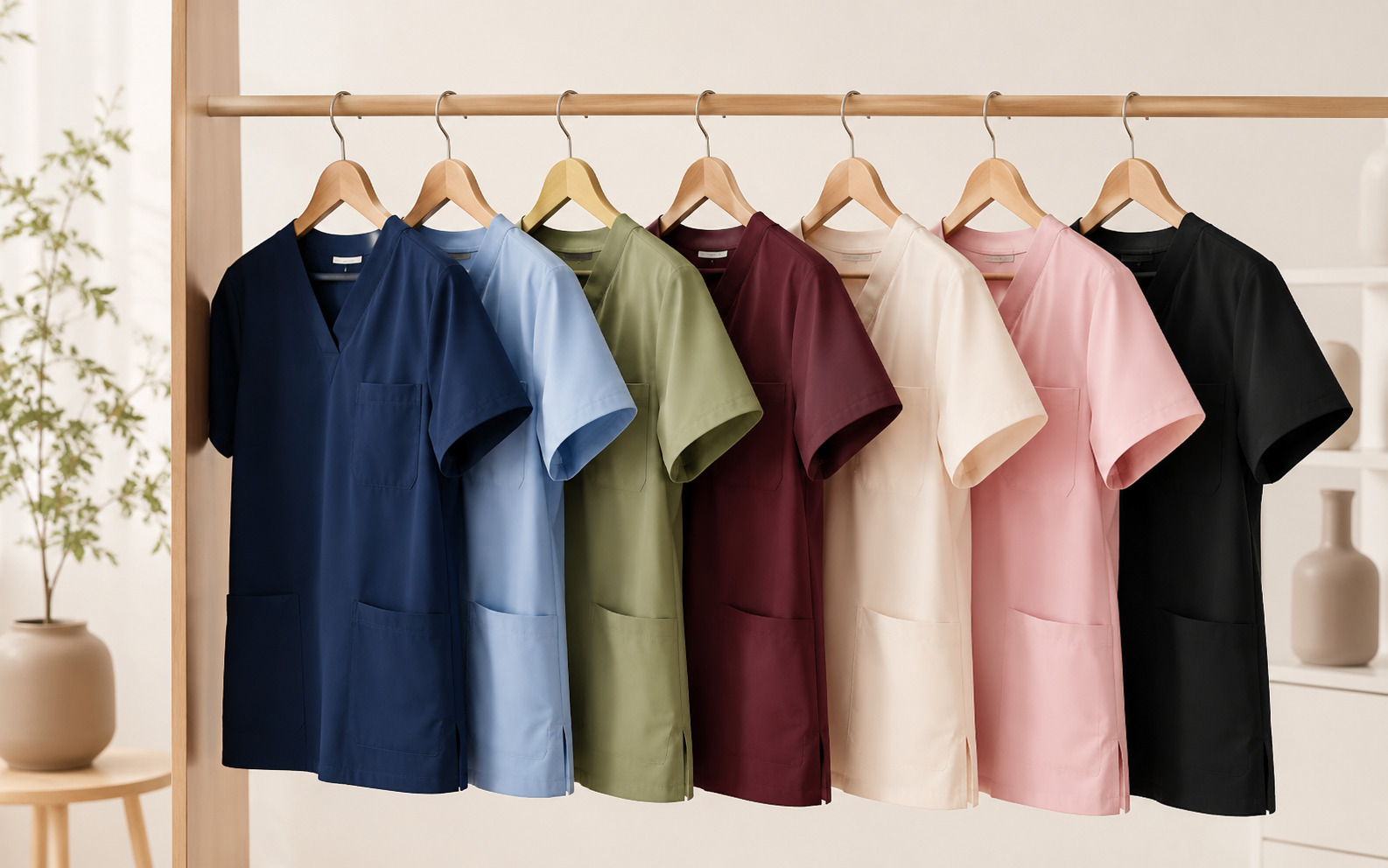
Which scrub colour is best? Quick answer
If you want the most universal option, navy is a very good starting point. It looks classic and professional and works well both in hospital settings and in private practices.
If you prefer a softer, less formal effect, consider light blue, sage, pale pink or cream.
Burgundy, deep green, plum, taupe and sandy shades can work especially well in elegant clinics, dental offices and aesthetic-medicine interiors.
Before choosing a shade, always check the dress code used in your workplace. In some facilities, colour is linked to a role, profession or department and cannot be chosen freely.
Table of contents
- Does scrub colour really matter?
- What studies show — and what they do not show
- What do different scrub colours mean?
- How to choose a scrub colour for your specialty
- How to choose a colour for the whole team
Does scrub colour really matter?
Yes, but not always in the simplified way suggested by pop-psychology colour guides.
A systematic review published in 2025 indicates that physician attire may influence how professionalism, trust and communication are perceived. At the same time, patient preferences vary according to specialty, care setting, culture and the overall context of the encounter. [1]
The same limitations apply to studies focused directly on scrub colours.
In a study published in JAMA Surgery, participants most often identified people wearing green scrubs as surgeons. Blue scrubs were more often associated with positive traits, while black scrubs were more often linked to negative ones. The study was based on photographs and included 113 respondents. [2]
In a later study concerning plastic surgeons, based on 562 responses, navy and blue scrubs were rated more favourably than black scrubs in terms of trust, knowledge, skill and empathy. [3]
These studies assessed first impressions based on photographs. They do not prove that colour alone improves quality of care, increases actual competence or triggers the same reaction in every patient.
Newer publications also show that results may differ depending on specialty and country. In a 2026 study involving 500 adult patients who assessed standardised photographs of an oral and maxillofacial surgeon, green, black and navy were among the highest-rated colours in most evaluated dimensions. Red usually received the lowest scores. [10]
In another 2026 study, involving 613 non-healthcare students from Oman, the United Arab Emirates and Bahrain, preferences focused mainly on blue and black scrubs, but varied between countries and clinical situations. [11]
These findings show how strongly colour perception depends on specialty, culture and the clinical context.
What studies show — and what they do not show
| Conclusion | What the studies support | What cannot be promised |
|---|---|---|
| Blue and navy uniforms are sometimes rated favourably | More positive first impressions in specific survey studies [2] [3] | An automatic increase in the trust of every patient |
| Green scrubs are often recognised as surgical attire | Association of green with the surgeon’s role and favourable ratings in some studies [2] [10] | Better treatment outcomes or improved staff performance |
| In some studies black scrubs received less favourable ratings | Survey results from surgery and plastic surgery [2] [3] | That black is always perceived negatively or as unprofessional |
| In other studies black was rated highly or was among the most preferred colours | Positive results in oral and maxillofacial surgery and frequent preference in the Gulf survey [10] [11] | That black will be the best option in every specialty and culture |
| Attire is linked to how staff are perceived | Associations with professionalism, trust and communication [1] | That clothing matters more than behaviour, competence and quality of interaction |
Can colour reduce stress or blood pressure?
The look of staff and the surrounding environment help create an atmosphere that may feel calmer or more formal to a patient. There is not enough evidence, however, to claim that scrub colour by itself lowers blood pressure or slows the heart rate.
So-called white-coat hypertension refers to elevated blood pressure readings obtained in a medical setting despite normal readings outside the clinic. The literature links this phenomenon to anxiety related to the visit, the measurement itself and the presence of medical staff — not to the direct action of the white colour of fabric. [4]
Colour can therefore influence first impressions, but it is not a therapeutic tool.
What do different scrub colours mean?
Colours do not have a single universal meaning. Their perception is influenced by culture, specialty, patient age, the type of facility, the cut of the garment, lighting and the entire surroundings.
Below we combine research findings with our experience in garment design and colour selection. Where science does not provide clear answers, we treat our conclusions as design observations rather than proven psychological effects.
Navy and light blue
Navy is one of the most universal colours in medical clothing. It looks professional, feels less severe than black and works across many specialties.
In studies concerning surgeons, blue and navy uniforms tended to receive favourable ratings. [2] [3] [10]
In a study concerning dental hygienists, navy was the most frequently chosen colour and was strongly associated with knowledge and skill. The study assessed a person in a photograph, not their actual competence. [5]
Light blue creates a lighter and more approachable effect than dark navy. It suits places where close contact with patients and a reduced sense of formality matter.
In the UNDAMED palette, navy stands for a classic, orderly image, while light blue is its fresher and less formal alternative.
Green and sage
Green is strongly associated with surgical environments and procedural medicine. Afterimages are sometimes cited as one of the explanations for using green and blue-green shades in operating environments.
After looking at a given colour for a longer period, the visual system can temporarily generate an afterimage in the complementary colour. Research on perception confirms that such adaptive mechanisms exist. [6]
This is not, however, proof that every green uniform reduces eye fatigue for surgeons or improves their work.
Sage is a calmer and more contemporary variant of green. It combines well with wood, stone, warm light and natural materials. It fits dentistry, physiotherapy, cosmetology and aesthetic medicine.
Burgundy
Burgundy can be an attractive choice for private clinics, dentistry, cosmetology and aesthetic medicine, especially when it is meant to complement a warmer, elegant interior.
It is deep and expressive, but usually looks less severe than black. At the same time, there is no basis for promising that burgundy alone increases patient trust. Perception depends not only on colour, but also on cut, lighting and the way the whole team presents itself.
How do we test colours at UNDAMED?
We wanted the UNDAMED palette to look professional without feeling cold or typically hospital-like. That is why, alongside navy and burgundy, we included calmer sage and lighter shades such as light blue, pale pink and cream.
We do not rely only on the colour visible on a screen or on a tiny swatch. We check how a shade looks on the actual fabric, near the face and in both daylight and artificial light. The same beige, pink or sage can appear warmer, cooler or greyer depending on the lighting.
Individual shades can be combined into a palette for the whole team or selected as one colour tailored to a specialty, an interior and the person who will wear it.
Pale pink
Soft muted pink usually looks gentler and less formal than navy or black. It works well in cosmetology, aesthetic medicine, gynaecology, paediatrics and beauty practices.
In a study concerning nursing uniforms, children often chose solid blue as well as bright pink patterned tops. In the full analysis, no simple relationship was found between colour and negative emotions. When the responses stating that “uniform colour does not matter” were excluded, white was the colour most often associated with eight negative emotions. The study included 233 school-aged children. [7]
This does not mean that a pink uniform automatically reduces children’s anxiety. It does suggest that staff appearance may matter in paediatrics and that less traditional colours can be well received.
In a study concerning dental hygienists, pink was associated with caring, but at the same time rated as less competent than navy. One colour can therefore evoke several different associations. [5]
White and cream
White is historically associated with medicine, cleanliness and professionalism, but not all patients respond to it in the same way.
A study carried out at ten academic medical centres in the United States showed that preferences regarding physician attire changed depending on the care setting. In many situations, professional dress with a white coat was rated highly, while in surgery and emergency care scrubs were more readily accepted. [8]
Cream is a warmer and less contrast-heavy alternative to pure white. It can look gentler, especially in interiors based on beige tones, wood and warm lighting.
With light colours, fabric weight, construction and opacity are particularly important. It is worth checking the garment both in daylight and under a strong treatment-room lamp. More about fabric properties can be found on the UNDAMED Fabrics page.
Taupe, beige and sand tones
Taupe, cool beige, sand, mocha and stone shades fit naturally into the aesthetics of modern offices and clinics. They do not look as clinical as white or as formal as deep navy.
They pair well with natural materials and minimalist interiors. They are especially suited to cosmetology, physiotherapy, dentistry and aesthetic medicine.
Before choosing beige scrubs, it is worth viewing the fabric in the real lighting of the practice. The same shade may look warm in daylight, grey under cool LED lighting or too close to skin tone.
Black
Black scrubs create a minimalist, modern effect and can work very well in aesthetic medicine, the beauty industry and tattoo studios.
In 2023 and 2024 studies concerning surgeons and plastic surgeons, black uniforms were rated less favourably than navy and blue ones. [2] [3]
Newer studies show, however, that the perception of black depends on specialty and cultural context. In the 2026 study involving 500 adult patients, green, black and navy were among the highest-rated colours in most analysed dimensions, including trust, experience, respect, cleanliness and comfort. [10]
In the survey involving 613 non-healthcare students from Oman, the United Arab Emirates and Bahrain, preferences centred mainly around blue and black. They still differed between countries and clinical situations. [11]
Black therefore has no single universal meaning. In some settings it may look more severe and create greater distance; in others it may be perceived as professional and modern.
In practice it hides some stains, but it also shows dust, light lint, fibres, pet hair and deodorant marks very clearly.
Can some scrub colours make you look older?
From the perspective of styling and facial appearance, some shades may look less flattering with a certain complexion or under a certain type of lighting. This is not a medical assessment and not a universal rule.
A very cool beige, earthy taupe or muted grey can emphasise shadows under the eyes. Very dark navy, black or burgundy may emphasise lines and imperfections, especially under harsh cool light.
Often it is enough to choose a warmer or more saturated variant. Cream can look softer than optical white, while muted pink or sage may appear gentler near the face.
It is worth trying scrubs both in daylight and under the lamps used in the treatment room. A colour that looks good in a product photo does not always look equally flattering near the face.
Which scrub colours are practical for everyday work?
Dark and mid-dark shades such as navy, burgundy, bottle green or plum usually hide water marks, pen marks and some cosmetic stains better.
On very light scrubs, coffee, foundation, products and damp marks become visible faster. On black, dust, powder and light fibres can be especially noticeable.
Colour must never determine whether a soiled uniform is still suitable for use. Textiles contaminated with blood or other biological material may contain large numbers of microorganisms and require proper handling in line with workplace procedures. [9]
We explain the Polish rules relating to washing and handling contaminated workwear in more detail in the guide How to wash scrubs without damaging the fabric or fading the colour?.
How to choose a scrub colour for your specialty
Surgery and procedural environments
Greens, blues, turquoise shades and navy are the most common. The first rule, however, is always to follow the standards used in a given department or operating block.
Dentistry
Good starting points include navy, sage, burgundy, light blue and taupe. The colour should look good under strong treatment lighting and match the character of the office.
When working with plaster and pale powders, very dark uniforms may quickly show visible dust. On lighter materials, colourful liquids and preparations may be easier to notice.
Studies suggest that colour perception can vary depending on country and treatment type. For that reason, dental offices should consider not only general associations, but also their patient group, surroundings and the way the team wants to be perceived. [5] [10] [11]
Paediatrics and neonatology
Consider light blue, sage, pale pink, warm yellow, cream or subtle patterns.
In the study mentioned above, some colourful uniforms were more often associated with positive emotions. This does not mean that every colourful outfit will be received in the same way by every child. [7]
Cosmetology and aesthetic medicine
Both light earth tones, sage and pink, as well as deeper burgundy, navy, plum or black can work well.
The colour may complement the interior, but it does not have to match it exactly. In an entirely beige room, a uniform a few shades darker may help the staff silhouette stand out more clearly from the background.
Physiotherapy and rehabilitation
A good direction is calm but not overly formal colours: navy, light blue, sage, olive, taupe or grey-blue shades.
As important as colour are fabric stretch and a cut that allows free movement.
Emergency medical services
In emergency care, identification, visibility and safety come first. Colour schemes and reflective elements are usually dictated by the rules used within a given service.
How to choose a colour for the whole team
Colour can become part of a clinic’s visual identity. You can use:
- one shared colour for everyone;
- different colours for different functions;
- a palette of several matching shades;
- a common base colour with varied details, embroidery or piping.
A team can look coherent without dressing every person in exactly the same shade. At the same time, it is not worth relying on colour alone to identify roles. The name and job title should remain clearly visible on the badge.
Which scrub colour should you choose in the end?
First, check the rules used in your workplace. Then assess the practicality of the colour, how it looks under treatment-room lighting and how well it fits your specialty and the rest of the team.
Navy is a good starting point for people looking for a classic, universal solution. Light blue and sage create a calmer effect, burgundy adds depth and cream is a warmer alternative to classic white.
Fashion trends can be helpful, but in the end the colour should match the workplace, the nature of the tasks performed and the person who will wear the uniform for many hours a day.
You can compare available shades and cuts in the UNDAMED scrub collection.
Scientific sources
1. Kim J., Ba Y., Kim J.-Y., Youn
B.-Y. “Patient perception of physician attire: a systematic
review update”. BMJ Open. 2025;15:e100824. DOI: 10.1136/bmjopen-2025-100824
Full
text
PubMed
record
2. Hribar C.A., Chandran A.,
Piazza M., Quinsey C.S. “Association Between Patient Perception
of Surgeons and Color of Scrub Attire”. JAMA Surgery.
2023;158(4):421–423.
DOI: 10.1001/jamasurg.2022.5837
Full
text
PubMed
record
3. Firouzbakht P.K., Zhang A.,
Nguyen D.C. et al. “Public Perception of Scrub Color and Style
in Plastic Surgery”. Plastic and Reconstructive Surgery – Global
Open. 2024;12(6):e5888.
Full
text
DOI: 10.1097/GOX.0000000000005888
4. Cobos B., Haskard-Zolnierek
K., Howard K. “White Coat Hypertension: Improving the
Patient–Health Care Practitioner Relationship”. Psychology Research
and Behavior Management. 2015;8:133–141.
Full
text
DOI: 10.2147/PRBM.S61192
5. Hendry C., Maayta N., Nafea L.
et al. “Scrub Color Affects Perceived Professionalism of Dental
Hygienists: A Cross-sectional Study”. Journal of Contemporary Dental
Practice. 2025;26(3):223–228.
DOI: 10.5005/jp-journals-10024-3836
Journal
publication
PubMed
record
6. Zaidi Q., Ennis R., Cao D.,
Lee B. “Neural Locus of Color Afterimages”. Current
Biology. 2012;22(3):220–224.
DOI: 10.1016/j.cub.2011.12.021
Full
text
PubMed
record
7. Albert N.M., Burke J., Bena
J.F. et al. “Nurses’ Uniform Color and Feelings/Emotions in
School-aged Children Receiving Health Care”. Journal of Pediatric
Nursing. 2013;28(2):141–149.
PubMed
record
DOI: 10.1016/j.pedn.2012.03.032
8. Petrilli C.M., Saint S.,
Jennings J.J. et al. “Understanding Patient Preference for
Physician Attire: A Cross-sectional Observational Study of 10 Academic
Medical Centres in the USA”. BMJ Open. 2018;8:e021239.
DOI: 10.1136/bmjopen-2017-021239
Full
text
PubMed
record
9. Centers for Disease Control
and Prevention. “Laundry and Bedding — Guidelines for
Environmental Infection Control in Health-Care Facilities”.
CDC
guidance on medical textiles
10. Yurttutan M.E., Kocamaz
Ö.F., Deniz B. “Impact of Scrub Color on Patient Perceptions of
Oral and Maxillofacial Surgeons: A Cross-Sectional Study”. Patient
Preference and Adherence. 2026;20:594237.
DOI: 10.2147/PPA.S594237
Full
text
PubMed
record
11. Qutieshat A., Al Amry R.T.,
Mustafa Z. et al. “Black is the new blue? A cross-sectional
Gulf Cooperation Council (GCC) survey of colour preferences for scrubs,
PPE and the dental clinical environment”. BDJ Open.
2026;12:37.
DOI: 10.1038/s41405-026-00426-z
Full
text
PubMed
record
About the author
The UNDAMED team creates and develops medical clothing drawing on experience gathered since 2012 in garment design, pattern construction and clothing production in Poland. We combine manufacturing knowledge with analysis of technical documentation and published scientific and industry sources.
When developing the collection, we assess not only the composition and performance of fabrics, but also the real appearance of colours on finished fabric and the way they behave in daylight and artificial light.