
Seventh hour of the shift. If your uniform works the way it should, you stop thinking about it. Learn what scrub fabric composition really means and how to read polyester, viscose and elastane on a label.
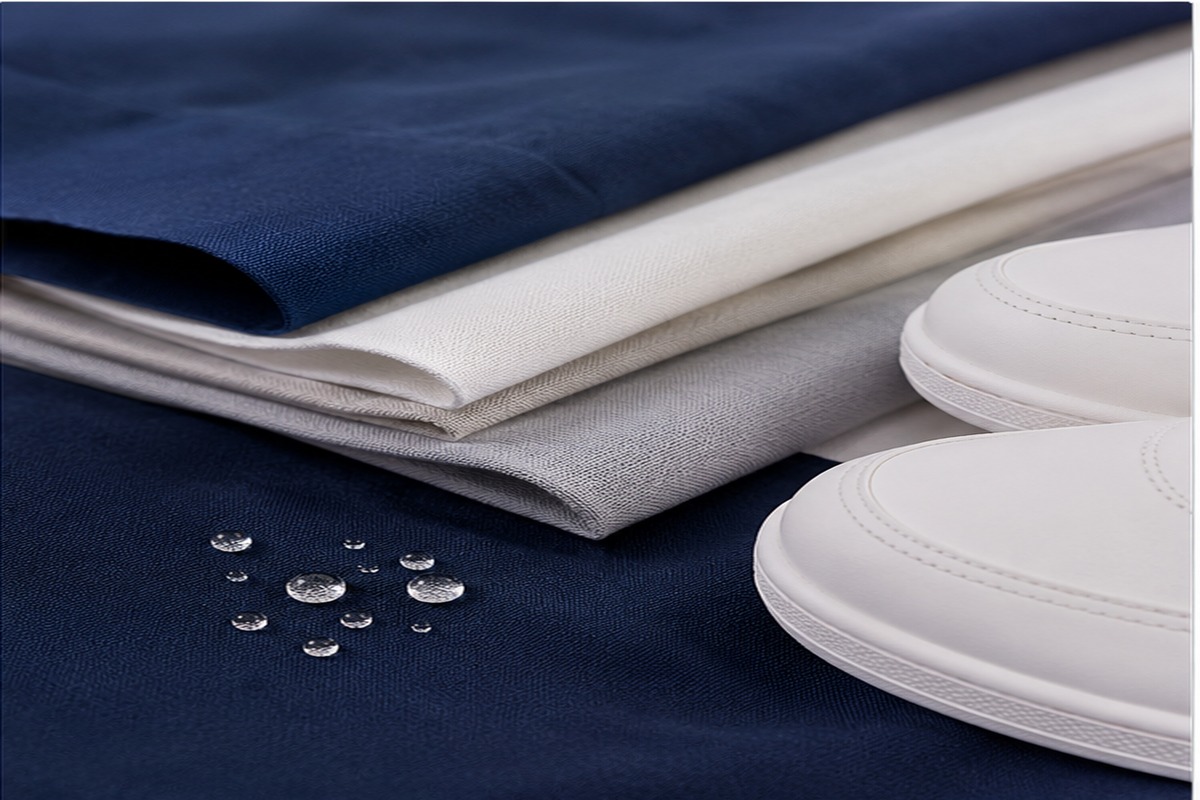
Seventh hour of the shift.
In the morning, your uniform was simply clothing. By now you have walked several kilometres along corridors, sat down and stood up many times, leaned over a patient, reached into a lower cabinet and taken your phone out of a pocket dozens of times.
If everything is working properly, you probably are not thinking about the uniform at all. That is exactly how it should be.
The problem starts when the fabric sticks to the skin, the knees bag out after a few hours and the trousers pull during a squat. At that point the small print on the care label suddenly matters.
60% polyester, 35% viscose, 5% elastane.
This is the composition of the fabric we currently work with when designing UNDAMED garments.
But what does that composition actually tell you? Is polyester the part you should be afraid of? Does viscose really “breathe”? What do spandex and elastane mean on a label? And why can two pairs of scrubs with exactly the same fibre percentages behave completely differently?
Let us look at the fabric more closely.
Polyester, viscose and elastane — the quick answer
In the shortest possible version: polyester is a synthetic fibre, viscose is a regenerated cellulose fibre with a much greater ability to absorb moisture than polyester, and elastane is an elastic fibre that allows a material to stretch and helps it recover its shape.
EU rules define elastane as a fibre containing at least 85% by mass of segmented polyurethane that, after suitable stretching, rapidly and substantially returns to its original length. [1]
That is a definition of the fibre. A finished fabric is more complex.
Construction, density, yarn type, weight, the way elastane is incorporated and finishing all matter. Research by Małgorzata Matusiak and Otgonsuren Sukhbat from Lodz University of Technology showed that liquid moisture transport in knitted fabrics changes depending on fibre content, structure and stretching. The study included materials containing cotton, polyester, viscose and elastane. [5]
So it is worth reading the label, but it is not worth treating it as a complete technical specification of the garment.
Spandex, elastane and LYCRA® — are they the same thing?
Spandex and elastane describe the same class of synthetic elastic fibres. “Spandex” is used mainly in the United States, while “elastane” is the usual term in Europe.
LYCRA® is not a third generic name. It is a registered brand of elastane fibre owned by The LYCRA Company. Not every elastane fibre is LYCRA®. [8]
If a label says 95% viscose / 5% elastane, the five percent describes the share of elastane fibre in the material. It does not tell you who made the fibre or how far the finished fabric will stretch.
The way fibre composition is declared in the European Union is regulated by Regulation (EU) No 1007/2011. [1]
Polyester — we know how it sounds, but what does it actually do?
Polyester has a poor reputation. “Synthetic means hot.” “The skin cannot breathe.” These statements sound familiar, but they say very little about a finished fabric.
Polyester itself absorbs very little moisture into the fibre. That is not the same thing as the ability of a whole fabric to move liquid between fibres and along their surfaces.
In the Lodz University of Technology study, different knitted constructions achieved different liquid moisture transport results. One cotton/polyester blend performed very well in an unstretched condition, and stretching the material changed some of the measured parameters. [5]
That is why “polyester does not breathe” is too simplistic. So is “polyester wicks sweat perfectly”. The behaviour of a finished material is the combined result of fibre type and proportion, fabric or knit construction, yarn, weight and finishing.
Why do we use polyester?
In the blend we currently use at UNDAMED, polyester accounts for 60%. We treat it as the structural base of the material, working together with viscose and elastane. We are not interested in one fibre in isolation. We are interested in the fabric from which a top or pair of trousers will actually be made.
Viscose — what does a cellulose fibre contribute?
Viscose is often described as “natural, but not quite”, which is understandable. Its raw material is cellulose, but the fibre itself is produced industrially. Under EU terminology, viscose is classified as a regenerated cellulose fibre. [1]
So it is not a natural fibre in the same sense as cotton or linen, but neither is it a synthetic fibre like polyester.
What does viscose contribute?
One important difference concerns moisture. In a study comparing wool, cotton, viscose and polyester, the viscose sample achieved a moisture regain of about 7.4% under the test conditions, while the polyester sample was around 0.3%. This illustrates the clear difference between hygroscopic viscose and polyester, which absorbs very little moisture into the fibre itself. [6]
In product development, however, a table or small swatch is not enough. We handle the fabric, crease it, assess its hand, place it against the skin and then sew a prototype. Only the finished garment shows how the material actually behaves on the body.
Does viscose “breathe”?
“Breathable” has become one of the most overused words in clothing. Thermal comfort depends on more than the name of a single fibre. CIOP-PIB describes thermal comfort using, among other factors, clothing insulation and heat exchange between the body and the environment; material testing also uses parameters related to water-vapour resistance. [3]
A more precise statement is therefore: viscose has a high ability to absorb moisture. That does not mean that every fabric containing viscose will automatically be light, airy and cool. The entire construction matters.
Elastane — what can five percent change?
Look at the numbers: 60% / 35% / 5%. Five percent looks almost symbolic, but elastane has a very specific role: it allows the material to work with the body during movement.
Research by Tea Jovanović, Željko Penava and Zlatko Vrljičak showed that elastane content influences the elastic properties of knitted fabrics and their behaviour under cyclic stretching. [7]
In scrubs, this is not most obvious when someone is standing still in front of a mirror. It becomes clear when they sit, squat, bend or raise their arms and you can see whether the fabric and the pattern construction are actually working together.
In one prototype, the top looked right while standing, but raising the arms revealed slight pulling across the back. We returned to the pattern and adjusted the armhole. In another fitting, a pocket looked fine until a phone went into it. We eventually deepened it by 1 cm. None of this information can be read from a fibre label.
Does 5% elastane mean 4-way stretch?
No. The percentage of elastane does not tell you in how many directions a finished fabric will stretch. Fabric construction, yarn arrangement and the way the elastic fibre is used all matter. Studies of materials with different elastane contents also show that elastic behaviour is the result of more than one number on a label. [7]
We therefore do not call a fabric “4-way stretch” simply because it contains elastane. Stretch also does not replace the correct size. Scrubs that are too small remain too small, regardless of how good the fabric is.
What does 60% polyester, 35% viscose and 5% elastane really mean?
It is tempting to reduce the blend to: polyester = durability, viscose = comfort, elastane = movement. Textiles are not that binary.
Polyester — 60%. It provides the synthetic base of the blend and the fibre itself has very low moisture absorption. The label alone does not tell you breathability, liquid moisture transport or fluid resistance.
Viscose — 35%. It provides a regenerated cellulose fibre with high moisture absorption and a characteristic soft hand. The label alone does not prove that the fabric will automatically feel cool or breathable.
Elastane — 5%. It contributes stretch and recovery after deformation. The percentage alone does not define 4-way stretch or a specific stretch range.
Fibre percentages primarily tell you what the material is made from and in what proportion. They are not a complete technical specification.
Two identical labels, two different fabrics
Two scrub sets can both say 60% polyester, 35% viscose and 5% elastane and still feel completely different. One fabric may be softer and more fluid, another more compact. One may move more during a squat, another less.
Weight, construction, density, yarn type, elastane placement and finishing all matter. It is a bit like bread: flour, water, salt and yeast can be the same, but every bakery produces a different loaf. Fabric works in a similar way.
Is a polyester fabric fluid-resistant?
You cannot determine this from fibre composition alone. Materials with barrier properties against water can rely on specific constructions, coatings, laminates or membranes.
CIOP-PIB distinguishes resistance to water penetration from parameters related to water-vapour transport and also points to the practical trade-off that increasing protection against water may reduce moisture transport. [4]
The presence of polyester therefore does not automatically mean fluid resistance. If a manufacturer claims a specific barrier or water-repellent property, look for documentation and testing of that particular material. The same applies to the word “antibacterial”: it does not follow automatically from polyester, viscose or elastane content.
What about cotton?
Cotton can be an excellent choice. “Natural”, however, does not automatically mean “best for every application”. Cotton is a cellulose fibre and absorbs moisture well, but fibre absorption is not the same as the way liquid moves through a complete fabric.
Research by Matusiak and Sukhbat shows that different blends and constructions behave differently and that stretching a knit can also alter liquid moisture transport parameters. [5]
So “cotton or polyester — which is better?” is too broad a question. A better question is: which material best fits the specific garment and the way it will be used?
How do we test fabric at UNDAMED?
First we look at it and touch it. If everything is promising, we sew a garment.
A small swatch cannot tell us whether knees will bag out after several hours or whether the same fabric will behave equally well in a top and in trousers. At an earlier stage we sometimes sew the same pattern in two different fabrics and compare how each material behaves on exactly the same construction.
After choosing the material, we sew the final prototype in the target fabric. We wear it, wash it and iron it. At that point we stop assessing a swatch. We assess a garment.
How should you read a scrub label before buying?
If you see polyester, do not reject the product simply because it is synthetic. Look at the full blend and the information supplied for the specific fabric.
With viscose, you know that you are dealing with a regenerated cellulose fibre with a high ability to absorb moisture. That still does not answer the question of the breathability of the finished material.
Elastane tells you that the blend contains an elastic fibre. The percentage alone does not tell you whether the fabric is 2-way or 4-way stretch or what its real stretch range is.
Finally, look at the garment as a whole. Even an excellent fabric cannot fix an armhole that is too tight, a badly positioned pocket, a trouser leg that pulls when sitting or a seam that irritates throughout a shift.
Polyester, viscose, elastane and cotton — a short comparison
Polyester: very low moisture absorption by the fibre itself; fabric construction can support liquid transport. Its presence alone does not define thermal comfort or breathability.
Viscose: high moisture absorption and a characteristic soft hand. Absorption does not automatically mean fast drying or breathability.
Elastane: stretch and recovery after deformation. Its percentage does not define the number of stretch directions or the exact stretch range.
Cotton: a natural cellulose fibre with good moisture absorption. It is not automatically the best solution for every application.
By the end of a shift, you should not be thinking about fibre content
Back to the corridor. One more patient. Another squat, another bend, a few more steps.
You are not thinking about polyester, viscose or the percentage of elastane. If the garment works as it should, it simply does not occupy your attention.
At UNDAMED we work with a blend of 60% polyester, 35% viscose and 5% elastane. We do not call it “ideal”, because there is no single ideal composition for everything. We chose it for a specific application.
Then we do what cannot be read from the label: we sew, fit, adjust, wear, wash and check again. For us, fibre composition is the beginning of the product.
Sources and basis of the article
1. Regulation (EU) No 1007/2011 on textile fibre names and related labelling and marking of fibre composition.
2. Polish Office of Competition and Consumer Protection / Trade Inspection — archived materials on textile composition labelling and controls.
3. Central Institute for Labour Protection – National Research Institute (CIOP-PIB) — materials on thermal load, thermal comfort and clothing parameters affecting heat and water-vapour exchange.
4. CIOP-PIB — materials on protective clothing against water, resistance to water penetration and water-vapour permeability.
5. Matusiak M., Sukhbat O. Influence of Stretching on Liquid Transport in Knitted Fabrics. Materials. 2023;16(5):2126.
6. Abedin F., DenHartog E. The Exothermic Effects of Textile Fibers during Changes in Environmental Humidity. Fibers. 2023;11(5):47.
7. Jovanović T., Penava Ž., Vrljičak Z. Impact of the Elastane Percentage on the Elastic Properties of Knitted Fabrics under Cyclic Loading. Materials. 2022;15(19):6512.
8. The LYCRA Company — technical information on spandex/elastane fibres and the LYCRA® brand.
About the author
The UNDAMED team designs and develops medical clothing in Poland, drawing on experience gained since 2012 in garment design, pattern construction and clothing production. When choosing fabrics, we do not stop at reading the label. We sew prototypes, test the material in motion, wear it, wash it and iron it. If something does not behave as expected, we go back to an earlier stage. People do not wear labels. They wear finished garments.